Showing posts with label christianity. Show all posts

Wednesday, November 10, 2021

(No?) nut november: Day 10. Research and religious nutbaggery

 First, this is completely OT. It has zero to do with abstinence and NNN.

Second: Confession time! I have a weird love for religious nutbags, occultism, esotericism, all that stuff. I love religion in general (as an atheist and skeptic myself), but specifically, I love when it's obviously ridiculous, alarmist, and stupid.

Obviously, my novel deals with just those topics, plus femalde dominance and tantra. So I get to do a lot of fun websurfing under the guise of "research".

Anyway, here are some fun links that I found just today:


Thursday, October 25, 2018

Why Christianity Does Not Work

There is a useful idea of transcendence buried inside christianity. *)

Christianity is an attempt
to transcend the ego,
by projecting the inner demon,
unto an imagined external being,
denying its demonic origin,
and then submitting to it.

I think it is reasonably obvious why this can never work.


*) inside abrahamic monotheism in general.

Tuesday, February 13, 2018

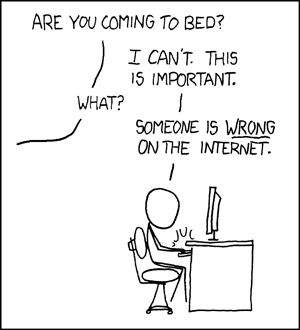
I stopped worrying about god, and you should too

https://xkcd.com/386/

For a long time, I was one of those pesky "New Atheists", fervently denying that that label had any significance (it doesn't), arguing rationalism on social media and defending against all types of fallacies.

This blog is a testament to that: See the labels atheism, bible, catholicism.

By the end of 2017, I changed.

What happened?


I rediscovered meditation and molded it into a serious formal habit.

I discovered stoicism and integrated it with my meditation.

I restarted my solo tantric activities.

As a result of all that, I took what I like to call the "sacred STFU vows". That means that I try to not engage in any debates, unless I have something useful to contribute.

There are two parts to this:

I try not to engage in any debates...


I don't debate my colleagues on their political views.

I rarely intervene on online forums about theism and atheism.

I don't even look at youtube comments anymore.

I basically logged off facebook, looking at it maybe once a week.

(Reddit remains my addiction of choice. I haven't given up on that one yet... probably will, later this year.)

There are challenges.


When a friend puts his antifeminism to me, I would like to stay calm, maybe react in a compassionate way, but not kindle the fire. What really happens is that, in person, I do engage in the discussion -- especially if there are beers involved -- while online, I don't react at all. Both are not exactly optimal. I'm working on it.

What I have gained by all that is more clarity, less useless outrage, a certain kind of "proud humility" and better insight into what matters.

What I mean by "proud humility" is the realization that I don't have to proclaim my wisdom all the time. I know what I know, I know what I believe, and if I keep it to myself for the time being, the world will revolve around itself just as it did before. Sounds humble? Well, it is also disciplined, and I take pride in my discipline.

It made me realize that I don't HAVE to engage all the time. I can refrain from it. I can click that link about money and sexual energy, then feel my gut reaction of "Durr, have to comment, have to destroy, krurrr murrrr", and let it go. There is incredible freedom in that ability. And it can be trained. All it takes is an act of nonaction.

Now, for the second part of my vow... "unless I have something useful to contribute".


Note that I did not say "something positive". There is an important distinction here.  Criticism, even negative criticism, has its place.

Of course, I can't always resist. I do comment. Way less than before, but I sometimes do.

My goal is to comment only when I feel there is no anger, and much compassion instead.

These past weeks, I had a few moments when I was there. I think those of my comments were worthwile. They make me proud. They might have helped people. And that is just a very, very good feeling.

As for god... I'm not sure. Maybe I'm not that advanced yet. I still feel a bit of frustration sometimes. But mostly, I have come to realize that those debates are utterly useless; tired old repetitions of the same 5 or 6 arguments, again and again. I'm not up for that anymore. I have better things to do.

So, should atheists refrain from debating christians?


In general, no. We are a social species, we need to communicate. But social media have made all that quabbling and quibbling and railing and wailing get way out of hand.

You need to put yourself back in the driver's seat.

If you feel that you might have gotten too far into #someone_s_wrong_on_the_internet territory, I suggest you take some time off. Get some distance.  Gain perspective.  Become aware of the emotions you put into those debates.  Ask yourself, what emotions do you want to experience? Ask yourself, what happens to you in those debates?  Ask yourself whether those two line up.  If they don't, it might be time for a change in strategy.

Sunday, October 1, 2017

Trying Street Epistemology

Last friday after the office, I went through a shopping street on the way to a good restaurant, for some baked cheese.

A little detachment from a group missionary project was preaching about the prodigal son. I listened for a while, partly out of sentimentality (I know the group from way back), but also because I really like to discuss religion. Nobody approached me, and the sermon was boring, so I moved on.

A guy followed me and asked to talk to me.

He was very polite, to the point of sweetness, very honest, very thoughtful, and had not a bit of that dreadful arrogance that some religious youngsters tend to display when they think they found The Truth.

So I exercised a little bit of what I know from Boghossian's "Manual For Creating Atheists".

It was an interesting and weird experience. On the one hand, I guess you can plant some seeds of doubt in someone's head, which is obviously a good thing. But on the other hand, I ran into a severe case of bite inhibition. That guy was 18, 20 years old. I have it all thought out, time and time again, read about it, listened to talks and debates, written about it. It's just so easy to get a guy like that stunned, stuttering, unable to give a coherent answer. It's almost unavoidable, if you grill him too much.

Of course he had seen my funny walk. Of course he told me about some prayer, where he had prayed for someone and that person was healed. Of course I know the fallacies behind that. Of course I know that memory is a creative act, and anyway it's not proof of anything.

I had him talking about his epistemology, asking how we could distinguish between good and reasons for believing something. He was off his script, and he didn't have all the answers laid out. He had to think.

All of this is good.

But still...

I don't want to do that. I want an honest debate. I want to be on equal footing. I want someone who can stand up to me, challenge me, make me think. I can't have that if my interlocutor just has no chance, due to age and experience and years and years of education.

So I left. I politely refused his offer to pray for me, and we parted ways.

Saturday, September 23, 2017

The long list of things I tried

Sometimes I'm amused by the sheer number of pseudoscientific and religious woo that I was involved in, or that I at least gave a chance, at some point. Especially seeing that during most of that time, I thought of myself as a somewhat rational person... After I wrote the list below, looking at it, I found it quite impressive and more than a bit shocking, really.
  • Fundamentalist christianity (of the catholic charismatic variety). Nothing to add here, really, we all know it's bullshit.
  • Satanism. I never actually believed it, but I was quite fascinated with Crowley for a while. I still think he's a very charming fraudster.
  • Kabbala. I never believed in it, but I read a lot of the literature and went to a lecture by the Kabbalah Centre once. I even gave a few talks on the history of it.
  • Tarot. I really wanted to believe that one. I even gave a few readings for money, until I learned about cold reading and realized that I had been doing exactly that all along, purely by intuition.
  • Wicca. I attended a wiccan ritual at some point, with high priestess and all. It was all very friendly and polite, but it felt incredibly shallow and noncommital. Coming from fundie religion, it just felt somewhat ridiculous. (Nobody was in the nude, by the way.) Oh and I had a little "temple" at home, consisting of a large cloth on which I had painted some symbols.
  • Buddhism. That one I'm still kind-of into. Over time, I learned to extract the meditative practice and reject all the metaphysical nonsense. I visited a real sangha a few times. I thought it was a valuable experience. I didn't crave any form of religious community at that point, so I never went back. I liked how the "sermon" was really more of a discussion with the whole group in one of those.
  • Tantra. Duh, you knew it had to be coming. By now I know how to distinguish between what's real and what's religious woo, so I can keep on practicing without fear of getting into anythng bad.
  • NLP (and other assorted communication teachings). That was the most expensive, by far. I did my self-hypnosis, which is one of the few things out of that whole mess that I would still recommend. It helped me give up smoking. But apart from that, it's just crap that turns people into monsters.
  • Pickup. Yes, been there done that. I never paid for any bootcamps or anything. I did get a few "lays", but I learned to see how destructive and inhuman it all really is, and I never overcame my "approach anxiety" in the long run.
  • Qi Gong, Tai Chi, Yoga etc. I would still recommend all of these, strictly as a physical workout. I practice some of it still, though I'm utterly incapable of performing any serious Tai Chi.
Just to show that I'm not completely cookoo, I never believed in: Astrology, crystals, pyramids, alien abductions, conspiracy theories, anti-vacc, Ouija boards, tachyons or Desteni.

Friday, April 7, 2017

How Rationality Came To Nicea

I can just picture it.

================================================


Basilides: So, what we gonna do about dat damn transubstantiation thingie, huh?

Augustine: Uh, man, dunno. Call Holy Ghost Busters, maybe?

Athanasius: Come on, man. Be serious for a bit, will you? We canna bloody well have them believe jus whatever, right?

Basilides: Okay, okay. We gonna solve that sucker right now. Forever. Like, when they go, ey, christianman, tell me how dat bloody oblate thing work, we gonna tell them: Yo man, it's magic, that's what it is.

Augustine: Nah. Canna do that. They's gonna look right through it. Gotta tell them something... you know... something awesome. Some big ass shit. Like, it's da faiths, or sumthin.

Origen: Yeeeeah, that's sounds like it. Faith. Always a good thing, right. Have a little faith in me and all that shit.

Basilides: Yup.

Athanasius: But ain't they gonna say, like, that not real rational an stuff?

Origen: Yeeeah, but I already have sumthin for them says that.

Athanasius: Like what?

Basilides: Yeeah, let's fuckin hear it, man!

Origen: Simple. We gonna tell em, god is what makes them logics be logical. God da powerman of rationality. Cos god made it all, so god made da logic, too, right? No way outta that one.

Basilides: Well, yeah, but then ain't they gonna say that if god made da logics and it's all fuckin rational, why doesn't it be so rational now with the Christ being in da oblate an all? Shouldn'ta be rational then?

Origen: You ain't grokkin it man. It's fuckin brilliant. They gonna say that, alright. But we gonna answer them thusly: God is rationality. No rationality without god. But you gotta have faith in god first. Cos, well, god is rationality. So, no rationality without god.

Basilides: Okay. Now I'm impressed.

Athanasius: Gotta go pee, folks.

Augustine: It's brilliant, man. It really is. It gonna work.

Origen: Don't tell me. Born a genius. Didn't choose it for meself. It's a curse as well as a blessin you know.

Augustine: How so?

Origen: I gotta walk this valley of darkness with all you suckers to the day I die.

Athanasius (yelling from bathroom): You get to spend eternity with us too, remember?

Origen: That's what makes it so frightening.

Tuesday, October 4, 2016

Do monks and nuns feel this way, too?

Don't even try to argue that you don't know what I'm talking about.

So... do they, or don't they?

Sunday, November 10, 2013

God Is A Bad Script Writer!

Interestingly, the gospels are written like a generic, run-off-the-mill hollywood script: There's three acts (childhood and backstory - the year(s) of ministry - passion, death and resurrection). There's tension and conflict in each. There is the obligatory plot point right before the end - Judas' betrayal, and the crisis that follows. There are obstacles to overcome, friendships to be started, there is struggle and betrayal and death. There is ultimate triumph.

The whole thing even has the "breaking of the umibilical cord" scene, when Jesus runs away to debate the clerics!

So, the question is: Is god just an unimaginative hack of a script writer?

Saturday, August 24, 2013

Are Atheists Mentally Ill?

http://blogs.telegraph.co.uk/news/seanthomas/100231060/are-atheists-mentally-ill/

This article, aptly titled "Are atheists mentally ill", informs us that, while nonbelievers are more intelligent than believers on average, they're also leading miserable, short lives spent in agony and depression. The article culminates in the claim that atheism is a form of mental illness, the implied conclusion being that one should start believing.

Now, like many commenters to that article, I sincerely do hope that the article is meant as satire. After all, the same site also features a rather clever article explaining why you can't use statistics to show that one individual person is more or less intelligent than one specific other person.

There is a lot to say about why such statistics are extremely dubious, my main contention being, as I've mentioned before, the suspicious absence of the standard deviation. There is also the issue of isolating one variable - faith vs non-faith - from all the others: In a culture where faith is accepted but atheism is not, of course atheists have good reason to be less happy than their religious friends; if you're more intelligent, it might imply that you see more clearly the evils in the world, therefore being unhappy, while at the same time intelligence might correlate with atheism (but not necessarily imply it); etc. etc.

And of course, every time someone mentions "a vast body of research", the dirty smell of a fish market on speed rises to the heavens.

The absolutely hilarious twist, though, is this: if you ask the question whether god exists, then "faith makes you happier" does not answer that question. If we were living in the matrix, controlled by machines, and the real world was a gehenna of destruction and chaos, then my belief in the illusory world created by the matrix does not change that fact. God either exists, objectively, or he doesn't. I I want to know the answer either way, both in case of the matrix and regarding god, even if the truth might make me extremely unhappy. Because, you know, if I don't know it I can do nothing about it.

No, faith is not a virtue, and trying to align one's worldview with actual reality is not "a tragic deficiency". It's merely an attempt to be honest. It's a form of humility strangely missing in those who place so much emphasis on following that most humble of godsons.

I don't get how people can believe that arguments like those are convincing.

It's not even about me defeding atheism against da evulz christians. I'd have exactly the same contentions with statistics biased in favour of atheism. (Only, somehow those rarely ever show up on my tiny screen. Probably because atheism really is inferior. Or because atheists are not stupid enough to even try...).

As I said, I hope that the article is satire. But I'm fairly certain it's not. And even if it were, for every Poe  there are a hundred people subscribing to such b.s. in sanctimonious, ernest sincerety. And that is just sad.

Saturday, August 17, 2013

A question to (catholic) demonology specialists out there

So, according to some, specifically the most mainstream christian traditions (like catholicism and mainstream protestantism), demons are fallen angels.

But, according to the same traditions, at least as far as I know, angels don't possess free will.

So, how do demons manage to rebel against god?

Thursday, February 28, 2013

"Cyclical Impact of Porn"


In the above video, youtube user anewchristian72 essentially tells us that porn affects young men's sexuality by filling them up (npi) with unrealistic expectations about female sexuality. I won't go into the fact that he equates porn with heterosexual porn, and bad het porn at that (and how about written erotica? How about comics?). Let's let him pass on that.

While it's not surprising that a christian rants against porn, I would like to point out a few aspects that I found particularly interesting with this little video:

One is that he only talks about the unrealistic portrayal of women in porn. I won't deny that this is true for the  vast majority of heterosexual pornography (one absolutely amazing exception being comstock films - if you have additional examples of porn that is actually good, please let me know). I would like to add, though, that the portrayal of men in het porn is at least as unrealistic. If we are to assume that this wrongful imagery influences young men in bad ways by way of false expectations, then shouldn't we assume that the portrayal of their own gender, with extremely huge cocks that are always ready, always erect, and their owners always horny and willing no matter what, is even more devastating to those young souls?

I was about to write, in accordance with anewchristian72's opinion and feminist mainstream, that the portrayal of women in het porn is a lot more denigrating than that of the male protagonists - but is this indeed true? Men are reduced to sex machines who have nothing on their minds except fucking women - how is this not supposed to be denigrating to my gender? Maybe there is some difference in quantity here, but certainly not in principle.

A second observation: He does not present any facts, he doesn't quote any studies, he doesn't even reference personal experience. I'm always amazed when that happens. How does he know what he claims to know? How can we test his claims to be true? As mentioned before, I like it when people qualify their claims with regard to their supposed ontological status.

Thirdly, I find it interesting how people just assume that young minds are impressionable, and therefore, whatever they see in whatever erotic product of their choice will be directly reflected in their sexual behaviour. I wonder if that is indeed the case. People don't go all panicky just because of some sci-fi flick. People don't run into the streets with guns after watching Die Hard. On the other hand, people are affected by advertisement, of course. I would like to know things like that in a little more detail, before starting off with sweeping judgments about the whole erotica industry based on a lot of ideology and little factual knowledge.

So, yeah, that's it. No punchline here, as I have to go home now and spend some quality time in bed with my girlfriend, the porn star.

Sunday, January 27, 2013

A little social experiment (for fun and... well, fun)


  • Declare yourself a christian.
  • Declare yourself not only that, but specifically a manichaean, pre-Augustine, Origenic, Pelagian, nontrinitarian, neo-gnostic christian.
  • Decry all other forms of christianity as heresy.
  • While doing so, constantly bitch about how your beliefs are being denigrated and marginalized by the evil mainstream heretic christian churches. Claim that the cross is an offensive symbol of oppression, baptism is the cause of sin, the eucharist is the devil's invention, etc.


How's that for a somewhat belated new year's resolution?

Saturday, January 5, 2013

A Chance Meeting

Yesterday, I ran into a girl I know from a coffee shop; a devout christian. We had a good talk, mostly about religion. We disagreed on many points, and agreed on some others. We parted, I think, both of us enriched and looking forward to our next encounter.

That's the way it should be.

Saturday, December 22, 2012

Unconscious Satanism vs. Free Will

Only recently, I encountered, once more, one of the oddest doctrines of christianity; which, even more oddly, seems to be very widespread, at least among literalists and fundamentalists. I don't know whether other mainstream religions have the same doctrine. It is, however, extremely popular with destructive and fringe cults.

I became interested, and I did a few google searches to find out about the history of said doctrine. However, I don't know its official name or proper theological terms to describe it, so my search was rather unsuccessful.

I'm talking about what I might call the "doctrine of unconscious satanism". In it, every non-believer is not only evil, but is a follower of Satan without even knowing it.

I will only touch the fact that the idea of unconscious, unintentional evil is somewhat dubious; or that, in the bible, god himself hardens the heart of the pharao, only to then turn around and punish his whole people in a true gorefest for the pharao's next actions; or that, back when I was a christian, there was also the opposite idea - Gorbachev, it was speculated, was an unconscious servant of god, much like Kyros in the old testament. (Yep, I'm that old, and that was indeed so long ago!)

Instead, let me focus on two highly interesting aspects:

1. This doctrine is almost unavoidable.

If it is true that one can only be in the Jesus camp or in Satan's host, and if it is also true that some nonbelievers claim to have nothing to do with the devil - then those people must either lie or not even know that they've been had. It is interesting to see that christians were not generally willing to presuppose that us puny nonbelievers are straight-out liars every time we open our mouth. Since they're essentially claiming that we're servants of the ultimate evil anyway, what difference does it make? Besides being a wee bit more polite, I mean. (But only really just a wee bit, if you think of it.)

I think the reason is more of a psychological than a theological nature: Christians were always forced to do business with non-christians, some might even fall in love with 'dem godless basterds, and it is just incredibly rude and impolite to accuse your local grocer (in my case, a muslim) of lying about having a contract with Old Nick, blood signature and all. If you think of them as completely deceived, that... well... it feels better. A bit. You're still surrounded by hordes of demon-ridden zombies. But at least they're not intentionally clearing the co-driver's seat for My Boyfriend When I'm In Hell.

And of course, you can't avoid it anyway. Once a dualist, always a scapegoater, as the old saying goes.

2. This doctrine is at odds with the christian doctrine of free will.

Once the devil has me, it is completely impossible to escape to find Jesus. The devil has complete control over the world; it's like the matrix, only even more so. The devil will always make me use the fiendish tools of logic and reason to convince me that there is not enough evidence, that auto-suggestion is not an adequate tool of determining objective facts, or that there are several major logical flaws in christianity's internal structure. Therefore, if the doctrine of unconscious satanism is indeed true, I have no chance, as an atheist, to ever decide that I want to become a christian.

So, how can a nonbeliever ever become a christian? After all, it seems that there are people like that. Does the devil trip up at times? How does one reconcile unconscious satanism with free will?

Of course, the easiest explanation is that ultimately, only god has the power to convert people. But that doesn't solve the problem - again, how does one reconcile that with free will? In what way is my will truly free, if it is simply a question of god intervening, or the devil gnawing away at my soul?

I'm sure there are numerous large theological volumes that have been written about just this subject. Sadly, my attempts at finding those have hitherto been very unsuccessful. If you have any pointers, please let me know - specifically, I would be interested in the history of this doctrine, since I have the impression that it is prefigured in the bible itself (god blinding pharao, Judas, etc.), and must also have its place in rabbinic thought in some form. I also hypothesize that it goes back to older, more rudimentary beliefs about spirits influencing people and demonic possession. I would really like to read something a bit more scientific about the subject.

Saturday, November 17, 2012

Job, interpretations, and jobs


Seth Andrews posted the following image on his facebook page today:


Christians will love to inform you that this is not the point of the story.

The point of the story is that god will reward you for keeping your obedience and faith in face of severe obstacles.

Personally, I think that one point of the story is that being good is not a ticket to a good life, and that life is simply unfair - I can well imagine that the reconciliation part was added later on. (Most theologians agree that the wager part was a later addition - there seems to have been some uneasiness about the whole oeuvre even in biblical times.) Or that it was not even meant to have a message, and was just an attempt at reflecting the relationship between the law, god, and human freedom.

After all, Job seems to have been written around the same time as such ominous books as Kohelet, Ruth, and Song of Songs. Those books don't seem to quite fit in with the rest of the Old Testament - to me, they always seemed to portray a somewhat deviant, reflective, almost rebellious attitude toward the law, the society of Israel, and all too self-assured righteousness.

But stories like that simply do not have one, and only one, correct interpretation. You do not write a story to make a point, and when someone then points out that there are other points to it that you didn't intend, you steadfastly deny it. I'm sorry, but that's just not how storytelling works.

Homer probably didn't intend us to read Odysseus as an opportunistic prick who had his fun outside of marriage for a while and was not all too unhappy about all the obstacles the gods threw at him (he did actively choose to listen to the Sirens, remember?). But heck, that interpretation is valid, and how!

Much the same way, the prodigal son can be read as a failed coming-of-age story. This one has always bugged me - it seems the superhuman grace of god can only ever be expressed in terms of unfinished or thwarted emancipation. Superdaddy will never let you go. He won't let you fly but he might let you sing. It doesn't sit right with me, sorry. It reeks of old wives' tales designed to instill fear and beat children back into obedience.

That multitude of meanings is there in every story. Of course, that's what makes a good story fascinating and captivating - but there is a price to pay: The author doesn't get to deny one interpretation just because it doesn't fit her original intention. Sorry, you should have written a different story then, or just plain told us what you wanted to say instead. Can't have your cake and eat it, too.

"God is an immoral monster" is part of the message of Job, regardless of whether the author wanted to say that or not. (And that message of obedience is, at the very least, morally dubious.) On a deeper level, of course, that's just what you get when you're an omnipotent being who created the world. It's unavoidable that bad shit happens, and god's outrageous and arrogant speech is nothing but the classic denial of a person in power who refuses to take up the responsibility for the mess they've made. Job shows us precisely what happens when people in power act like that: The subordinates suffer. We see that happening in offices and workplaces around the globe on a daily basis, and Job does a terribly good job (npi) of presenting god as the ultimate uncaring, antisocial villain.

And who knows - maybe that WAS the original intention, after all?

Tuesday, September 4, 2012

Meditation? Meditations!

http://www.slate.com/articles/arts/culturebox/2003/02/buddhist_retreat.html

In the above article, to which I might come back again in a later posting because I believe that it contains a few very valid points, the author makes a claim about buddhist meditation: namely, that it is a highly unreliable tool and can even "exacerbate depression, anxiety, and other negative emotions in certain people."

Now, I certainly think that this can be the case; most books and articles I read on the subject admit that there can be issues, and that people with severe mental problems should probably stay away from meditation. They then move on to state that those cases are extremely rare.

In my personal life, meditation has had a tremendously positive impact, so I cannot attest to anything else. But I sure understand, on an emotional as well as intellectual level, how feelings of losing one's self, of "unreality", might put some people in a lot of dismay. Personally, I always fancied meditation to be a rather safe method, for the simple reason that you have to put in quite a lot of time, that you have to practice on a very regular basis for an extended period, in order to actually achieve anything. It has its own safeguard built right into its core, so to speak.

But that is not entirely true.

The more I think of it, the more I conclude that meditation is not one thing, but many different things.

If you sit down to meditate, regardless of the method you employ, there will always be thoughts passing through your head. And some of those thoughts will be about the meditation you're just having. In other words, you do interpret your meditation while you meditate. In all practices I know, the goal is letting go of exactly those interpretations - but since this is basically a life-long journey, those thoughts, those interpretations, will be with you for quite a while. And, since you cannot easily have a clean cut between your thoughts and "what meditation really is", that wordless state, your thoughts are actually a part of your meditation. Your words shape your experience of wordlessness. And those words, of course, are themselves informed by your religion, ideology, worldview - especially if your meditation is an integral part of your religion.

If you sit down thinking that you're now enjoying the presence of Jesus, this is a whole different experience than if you sit down with the assumption that you slowly realize that your self is an illusion, which will eventually lead you to enlightenment.

So I posit that christian meditation is not just meditation with some added christian flavor, but a completely different affair than buddhist meditation. The same goes for every other "type" of meditation out there. They are all wildly different affairs.

And of course, this also implies that some of those interpretations are more wholesome than others. I guess that the types of meditation that get practiced in destructive cults tend to be of the not-quite-so-wholesome kind. A meditation engulfed in pressure and idolization of a leader... nah. Can't be all that good.

So, it's never really "just sitting". I think this is something to be aware of when you start a meditative practice.

Tuesday, August 21, 2012

"Faith And Reason" (a letter to Fr Robert Barron)


Dear Mr Barron,

this is probably the first in a series of open letters to you.

Why you?

Simply because you turned up in one of my youtube binges one fine day, you openly perform evangelist and apologetic work as a priest of the roman catholic church, and so I tend to disagree with most of what you say. I dig debates, so I started asking questions on your channel.

Now, you have long ago banned me from that channel, so I can't ask any more questions there. So I'm doing it in my own blog instead.


In your video about "Faith and Reason", you quote Thomas Didymus and Thomas Aquinas as examples for the roman catholic church welcoming questions. "After all", I hear you say, and I paraphrase, "Thomas Aquinas asked whether god exists. If that question can be asked within the church, so can any other question."

I find that a bit ironic. After all, what do those two Thomases have in common beside their name?

Assuming that Thomas Aquinas' answer to the question whether god exists was an emphatic negative, a deeply convinced "NO" -- would you still be quoting him? Chances are, no.  He wouldn't be a "saint" of the roman catholic church. He wouldn't even have lived long enough for that. He would be a sidenote of history, yet another victim of the church's welcoming way to deal with people whose questions, and more precisely whose answers to those questions it dislikes.

No, I do not bring up ancient issues to damn the church. It wasn't me who started quoting Aquinas here.

In other words, my suspicion is that the church, and -- as far as you represent that church -- you, Mr Barron, welcome questions and rational discourse just as long as the answer is exactly the one you like. Yes, one may ask whether god exists, or whether Jesus is the messiah - as long as the answer to both is a loud and clear "yes".  And that seems patently absurd to me. Correct me if I'm wrong...  You strike me as an exceptionally intelligent and learned man, so I wonder what your answer to that might be.

You then move on to talk about Faith being "suprarational, surrender from the far side of reason". And then at the core part of your video, you make a very odd switch... suddenly, the juxtaposition is not about Faith and Reason, but about Faith and Rationalism. You say:

"Is it wrong to question - no. But is it wrong to be so aggressive in one's rationalism that one wants utterly to control the situation - yeah. That's a problem. Cause you'll never get god that way with our grasping, self-asserting minds."

Let me repeat that one more time: CAUSE YOU'LL NEVER GET GOD THAT WAY. Something is wrong because it doesn't lead to the answer that you have already set up to be true. I think that this is a very interesting slip there.

What exactly do you mean by "rationalism"? The textbook definition is "any view appealing to reason as a source of knowledge or justification." That can hardly be what you mean.

See, what I don't get is this odd pairing of rationality and "controlling the situation". It's not like you're the first one to come up with that.  It's an old stock item from the staple of religious apologetics.

Of course, I can only guess what's actually meant by that term. Usually, it tells us something about a person's behaviour in their social relationships. A guy can control the situation by not listening to his girlfriend, by putting words into her mouth, by applying manipulative language or plain old violence. But that's not the context of your video. The context of your video is you trying to set up Faith as a valid source of knowledge or justification. It is trying to show that there are things beyond reason. There is no relationship there. It's a question of facts -- either things do exist that are not to be explained by reason, or not. And the burden of proof is still on your side, of course.

Actually, let me submit an alternative view: Contrary to being a form of self-assertion and control, adhering to reason is a form of submission.  In adhering to reason, e.g. by calling myself a skeptic, I submit myself to a set of well-known, well-defined rules. If I then move on to violate those rules, you can call me out on that. If my syllogisms don't work, or my premises are doubtful, or I show no evidence for my claims - you can criticize me. I may grumble and grouch, but ultimately, I cannot but accept that you're simply right. That's the beauty of reason -- it is universal and takes no sides.

I fail to see how that is "controlling".

Where is the same form of submission in Faith? In Faith, you cannot criticize the sacred doctrines. In Faith, there is no way to have a debate, to amend one's views, to get a better understanding of reality.

Is it not the case that, contrary to your position, Faith is the ultimate form of control? In Faith, you get to choose what you want to believe, and ain't nobody gonna take it away from you, ever. There is simply no way, based on Faith, that I could convince you of anything.  You control the situation much, much more than I do. It's you who ban unwanted commenters, not me. (I'm not butthurt about it, I just made the experience that it is rather symptomatic for apologists.)

But let's not end it here. I know that your reply (in a purely metaphorical sense -- of course you won't ever honor me with an actual reply) will be along the lines of, "that is not what I mean by Faith.  That is not True Faith." And beside the obvious No True Scotsman there, I actually agree.

Let me submit yet another little proposition here: Faith is the position that there is something beyond reason. We cannot hope to falsify that.  But we can safely say that there is no reasonable way to talk about whatever is "there", beyond reason.

I think that you, and your church, completely and utterly fail in going all the way. And that's what we need to do: GO ALL THE WAY. There is probably something beyond reason, and we cannot talk about it, so LET'S STOP TALKING ABOUT IT.

Yes, I do understand submitting to the transcendent. And I think that that is, to a part, what you're aiming at -- most probably it's something that every somewhat mature human being is striving for: transcendence. And of course, we're all failing at it, all the time. And that's okay.

The mistake I see is not having Faith per se; the mistake is having Faith IN SOMETHING. In a doctrine, a dogma. "God is a person", "God is love", "God thinks that premarital sex is wrong". All of those are speculations. Nothing wrong with speculations, but one shouldn't treat a speculation as a fact. (The same goes, of course, for "universal energy", "karma", "the law of attraction", etc.)

You cannot set something up to be beyond reason, and then move on to talk about that something as if you knew it.  It's having the cake, and eating it.  As I'm sure you're well aware after years of academic study in theology and philosophy, in order to talk about something you always need reason.

The mistake is, as I like to call it somewhat cheekily, falling for one's own bullshit.

The moment the roman catholic church stops falling for its own bullshit, and starts recognizing that it has no clue about god, or about Jesus, or about the trinity, is exactly the moment that it may become useful for humanity.

 With kind regards,
Skeptic Tantrika


Saturday, August 11, 2012

The Münchhausen Trilemma, the First Cause and the Infinite Regress

This is yet another topic that I have put off for far to long. Initially, I wanted to make a youtube video on the topic, but it never came to be, so here it comes in written form, which is probably better anyway. It's going to be a long ride, please bear with me.

The Starting Point

One favourite argument of First Cause proponents is a reductio ad absurdum of the opposite. I get to hear it from theists, but of course you don't have to be a theist to put it forward (except in the strict philosophical sense, where god is simply the absolute, not necessarily a person or an intelligence).

The argument works something like this:
  1. Every event has a cause.
  2. An infinite regress of causes leads to an absurd result.
  3. Therefore, there had to have been a First Cause.

The Reductio In General

A reductio ad absurdum is, of course, a valid form of argument - some go so far as to say that it's the queen of arguments. It works to exclude answers from the spectrum of possibilities. If an answer leads to impossible results, then that answer cannot be true. That's just simple logic.

This is not at all far-fetched or highly philosophical. Proofs of that nature occur, for example, in computer science, where it is customary to show that if a proposition were true, then it would solve the halting problem. Alan Turing proved that the halting problem is unsolvable, therefore the proposition in question is false. (If you suspect that I have a weird tendency to bring Turing into my articles, you're right. Read up on his biography - the guy was a genius, a war hero, an uber-geek, and a highly tragic figure. He committed suicide by eating a poisoned apple. No kidding.)

It's a way to rule out impossibilities - the Sherlock Holmes way of excluding impossible options so you can focus on those that are indeed realistic.

If you try to use this argument to prove one specific possibility, your success hinges on the following conditions:
  1. The premises of your argument must be agreed upon.
  2. Your argument must be consistent.
  3. You must show that you have actually excluded all options except the one you're trying to prove.
  4. The one option you're proposing must, itself, not lead to absurd results.
So let's have a look at the reductio argument for a First Cause to see whether it meets those criteria.

The Premises

"Every Event Has a Cause"


Can we agree that every event is caused by something else? At first glance, it certainly seems that way, as we would be hard-pressed to come up with an event of which we can show that it is uncaused. (As always in such discussions, I hereby make a sacred vow not to invoke quantum theory.) We know that everything is caused - we know it from our experience. Indeed, we know it from every experience that any human being ever had. That's an awful lot of experience!

Aye - but it's still experience. And that's a bummer.

It's called inductive reasoning. A synthetic proposition a posteriori, as Kant would have called it. What that means is that, while it seems extraordinarily probable that the next event we encounter will have a cause, just like all the events we encountered in the past, we don't know that for sure. We cannot be absolutely certain. We can predict, with almost 100% certainty, that it will be the case - but almost 100% is not the same thing as exactly 100%!

So, actually, no, we cannot agree on the first premise. Not to the degree that would be necessary for a point about the absolute, a priori, First Cause.

(Oh, and, by the way - if the First Cause caused everything else, where the heck did causality come from? If the First Cause caused it, then using it to prove the First Cause is, itself, circular. If the First Cause didn't cause it, then what caused it, and how can the First Cause be said to be... well... the First Cause?)

"An Infinite Regress Leads to an Absurd Result"


This is, obviously, the core of the argument. The logic here is pretty impressive and has fascinated me from my first adolescent forays into philosophy until now:
  1. There is an infinite chain of cause and effect.
  2. An infinite chain cannot be traversed.
  3. In order to ultimately explain any given event (like, this moment right now), you have to traverse it's causal chain.
  4. Therefore, you can never explain any event.
This is impeccable logic. For as long as I thought that ultimate explanations are a good and even necessary thing, it caused me lots of pain. Then I started to relax. Now I find it rather amusing.

Of course, on top of relying on causality being universal and absolute, this introduces even more premises that have to be agreed upon.

Sidenote #1: Is Causality a Property of Things?


It's an interesting question to ask yourself: What exactly IS a cause? When we say that B is caused by A, do we actually mean that B has an intrinsic property that can be called "is caused by A"? Is a cause a property of things?

I'd like to introduce a little example here. Picture a child throwing a stone at a window. Predictably, the window breaks. But what exactly is the cause of the window's demise?
  • The child is the cause? That's one intuitively correct answer, of course.
  • The stone? Yet another correct answer.
  • The momentum that the stone put into the glass?
  • The child's intention in throwing the stone?
  • The child's brain's activity that represents said intention? (Note: it does not CAUSE the intention. It IS the intention, on a biological level.)
  • The bad upbringing of said child by her parents?
  • Society at large?
I'm sure that you can come up with a few more examples, some more useful than others. Some might even be comically absurd or mere esoteric hypotheses.

(And of course, you can put most of them into an order of temporary succession. Did I mention that causality is not necessarily temporal? I won't go into it here, it's a fun little riddle for long lonesome (k)nights.)

The point is, though, that you can invent any number of causes. Some are practical and some might be rather obscure, but they're still possible answers. Nobody can keep you from naming the air that the child breathed as one cause of the child's throwing the stone.

This may lead us to the hypothesis that causality is not simply an attribute of things. If it were, then how come we can come up with any number of possible answers to the simple question "What caused event X", all of which are equally true? If causality were a naturally existing, universal attribute of things outside our brains, then there should be exactly one answer to this question, and everyone should be able to agree on it (stupidity and willful ignorance aside).

I propose that causality is, at least partially, a result of human thought processes. Of course, our brains evolved to work in the real world, so most probably there is some kind of correlation to natural phenomena outside ourselves. But it is not fair game to simply call this outside factor "causality" and leave it at that.

Sidenote #2: Is Causality a String of Events?


In order for the original argument to work, causality must be thought of as a string of causation leading to the past. Picture it as a string of pearls put on a chain. A very long chain. Very, very long.

I think that this is an oversimplification. It is useful (and customary) to distinguish two different classes of causes: necessary and sufficient causes.

"The street is wet." - Well, it rained the whole day. That would be sufficient to explain the wet street. Since there were no other events to explain the effect, it is also its necessary cause.

On the other hand, picture a slightly more complex scenario: A wedding. It is highly recommended for the bride to be present. The same goes for the bridegroom, the priest, and the witnesses. On top of that, it's rather practical if they all agree to have a wedding, and if nobody shows up at the last moment to speak up now, rather than be silent forever. So we can easily say that every person's presence is a necessary cause (all of them, seperately), while the whole array of conditions together form the sufficient cause.

Ah-ha! It seems that there may be any number of necessary causes, and all of them together can be said to be the sufficient cause of an event.

So, if we look only at sufficient causes, then we do get our string back... or do we?

Remember the child from further up. The child had to throw the stone a certain way (necesary). The glass had to be there (necessary). The wind had to blow the right way and strength (necessary). Together, they form a sufficient cause. But every single one of those necessary causes depends on a new string of causation. It is not easy to see how this tree of causation would, at some point, magically collapse into one simple string that leads to one First Cause.

If causality were just a succession of pearls on a chain - shouldn't it then be trivially simple to point out the one cause that immediately precedes any given effect?

I'm not saying it's impossible. But it's yet another telltale sign that the idea of a string of causation leading back to the First Cause is just a bit too simplistic.

Sidenote #3: Do We Have Infinite Regress Anyway?


Furthermore, it seems to me that we can make up any number of causes in-between causes.

"The child threw the stone, and it caused the glass to break." - Yes, and in between this and that, the stone followed a certain ballistic curve. At about 1/3rd of its way, the wind moved the stone slightly to the left. So the position of the stone at this point, its momentum, and the wind, ultimately caused the glass to break. Yes, and about another 1/3rd from this point to the window, a bird flew by and caused pressure in the air, which moved the stone again. So ultimately, the bird caused the breaking of the glass.

See what I'm aiming at? At every single position along its way, it can be said that the stone's current position, plus its momentum, caused its further path.

Between any event and its direct necessary cause, you can always find another cause. Hypothetically, this goes on ad infinitum (again, not taking quantum mechanics into account).

It's a bit like natural and real numbers: Between any two natural numbers, there are always infinitely many real numbers. You cannot traverse them. You can only jump over them to reach the next natural number.

But if that is the case, then it doesn't matter whether we have a First Cause at the beginning. Right between the First Cause and its First Effect, there was already an infinity of causal relationships. We have an infinite regress anyway, always, regardless. So the First Cause doesn't actually solve the problem. Instead, it introduces one more problem by setting up a dogma for no good reason.

Did We Cover All Options?

As stated above, if we want to use our argument from absurdity to show that our favoured option is true, we have to make sure that we excluded all possible options.

The Third Option: Circular Logic


As the title of this article suggests, there is at least one additional option that we have not covered.

In its classical form, the Münchhausen trilemma states that, on top of infinite regress or a first cause, you can always resort to circular causality. Of course, as we all know, circularity is a logical no-go. So is the infinite regress, and so is dogma. That's the whole point of the trilemma: All options are equally absurd.

But I'm aiming at something else here. I'm not exactly certain whether the third option actually is one. Neither am I convinced that it's not. And, reading a few articles about it, I get the impression that really, nobody is to certain in that regard. Circularity might be seen as a variation of the infinite regress, but there is also a point to be made that it's a variation of setting up an absolute. Or that it's a third, independent option. I don't know. And as long as there is no good argument to exclude any of those options, we cannot exclude the possibility that there is at least one more possible answer to the question of the ultimate cause. Maybe there are even more? How would you go about showing that such a thing is impossible?

Ironically, the official doctrine of the catholic church, which obviously opts against infinite regress and in favour of an absolute First Cause, is suspiciously reminiscent of the circularity variation: All existing things need sustenance, but god provides its own sustenance and is therefore absolute... or... circular... or... infinitely regressing... or... To me, this has always seemed a lot like an excuse. They don't want to put the absolute First Cause right in your face, but they want to set it up anyway, so they invent something like an "additional realm of being", in which circularity is somehow allowed.

So, Do I Propose An Infinite Regress?

Short answer: no. I cannot stress this enough. My dear friends on the theist side always seem to get this wrong, pretty much regardless of what I say. I am not proposing that an infinite regress is a good solution. I concur that an infinite regress leads to an absurd conclusion. But I also state that setting up any one "thing" (i.e., god) as an absolute First Cause cannot save us from the anxious question of what caused it. And of course, circularity doesn't help us either.

I think it's an unsolvable problem. And I think that there is a very good reason for why it is unsolvable.

If Causation Is Not A Property Of Things, What Is It?


I think the answer lies in the fact that causation is not a property of things. We should treat it more like part of our model of the universe, rather than like part of the universe itself. A highly successful part of this model, mind you - but still, the model is not the airplane.

That way, we can opt for either one of the three options, depending on what is more practical in a given context.

For example, with regard to societies and human interactions, a somewhat circular approach is probably more than appropriate: Complex systems of interactions looping back to their causes.

With regard to classical Newtonian physics, of course, linear causality makes perfect sense: the ballistic curve is strictly deterministic.

I don't have an example for where it's useful to use a dogmatic First Cause. I'm hesitant to say it, but it might actually make sense in cosmology. It's perfectly okay to say that your model of the whole universe is based upon a First Cause, simply because it may be rather practical to do so - as long as you don't think that you're actually talking about actual properties of the universe itself, there is no issue with that.

Of course, there is probably a very good reason for why we don't seem to find the answer to Münchhausen's trilemma: Causality may be hardwired right there in our brain. The reason for that being that it just works great within nature. (Now we're close to circularity.) The reason for that being that there is a correlate of causality in the universe, which itself has no reason at all. (A dogma!) Or which is caused by something else which we haven't discovered yet, which is caused by something else which is caused...

Summing It Up

So... after all this long-winded talking, here's the executive summary of my contentions:

  1. Causality is only derived from experience.
  2. Causality is not necessarily linear.
  3. There may be infinite causes between each pair of cause and effect.
  4. Causality is not a property of the universe, but rather of the way our mind works.
  5. All answers that we can give are equally unsatisfying.
  6. There may not be an ultimate answer.
If you enjoyed this, you might want to take a look at the addendum here.

Wednesday, April 11, 2012

Empathy, Reason, Presuppositional Apologetics

The following are very rough, and partly speculative, outlines of how I see empathy, reason, their interrelations, and what kinds of conditioning can overshadow one or the other. As one major example, I show how Presuppositional Apologetics serves as a mind-trick to block out those basic human capacities by way of circular logic and self-referential tautologies.

There are two major basic tools to help a human being connect with another human being: reason, and empathy.

1. Empathy as a visceral tool of connection

We use empathy to understand each other on a non-intellectual level.

We don't need to agree on anything in order to be able to empathize. Using empathy, we realize on a visceral, rather than an intellectual level, that we are all just humans, that we all suffer, that we all desire and love and hate and want our basic needs met, and have the same rights.

When I see a beggar on the street, my empathy triggers - it's not even voluntary. Sure, conditioning and thinking can interfere with empathy, can add a layer to numb it out, and it's sadly necessary to have that additional layer in a modern city where I encounter several beggars each day. In a similar way, the butcher cannot afford to empathize with the pork, and the surgeon cannot empathize with the person on whom she is performing open heart surgery. They have to habitually suppress their empathy with regard to their working material - otherwise, they simply couldn't do a good job. But that doesn't change the fact that there is an involuntary part in my brain going beep-beep, fellow human in trouble. (This is, of course, a hugely oversimplified example - in reality, a lot of unconscious factors play into this, such as the beggar's attractiveness, gender, age, etc.)

It is a capacity deeply ingrained in our brains, and rather astoundingly, it even extends to other species. I can totally empathize with my cats when they meow for their daily fix of Whiskas(R), even though they probably won't agree with me on climate change, or nuclear power, or atheism for that matter.

Interestingly, empathy doesn't seem to extend so much to slugs, snakes, poisonous spiders or the HI virus. It seems that the more removed from humans a species is on the tree of evolution, the less empathy it gets. To take it even further, I don't think anyone really empathizes with a rock - or with 2004 MN4 "Apophis", the asteroid who will probably hit earth in 2036, for that matter.

It is not a "perfect" tool, it is more like an axe than a razor. As such, it is a perfect example of a trait acquired through millions of years of evolution. (And that is also why every metaphysical, religious view of "love" as a superior aether or gift will always fail - it simply is not that.) But it is the best thing we've got for this very specific purpose - to help us connect with each other, and with our environment at large.

2. Reason as an intellectual tool of connection

We use reason to understand each other on an intellectual level.

And here, too, there is a large involuntary part. A trivial classic syllogism can show this: Once you've accepted that I'm a human being, and that all human beings are mortal, you will have a hard time not seeing that I am mortal.

Sure, you can deny it. And there are definitely circumstances that will keep you from seeing the obvious. But, in the absence of those circumstances, I bet that you cannot help going along with correct logic. (We can discuss whether this is an absolute, a necessary presupposition, or an arbitrary set of rules that just works, but that's beyond the scope of this article.) As soon as you have understood why time is relative, it is virtually impossible to convince yourself that it's not, regardless of how counterintuitive the concept seems.

The interesting part, of course, are the factors that can keep us from applying reason: If you're upset, if you have a strong emotion attached to the speaker, if what they say goes against your core beliefs, if you see it as a personal attack, etc.

The trouble is that reason is a much, much more fragile capacity than empathy. Maybe that's because we developed it way later in our evolution from happily floating cell to homo sapiens concerned with the stock index; and on a similar note, it's because reason is less visceral, and more intellectual - because it requires more neocortal activity, a.k.a., thinking - and thinking is hard work. (I'm not even being snide - spend a few hours on a complex philosophical riddle, and you'll see my point.)

But - as with empathy - reason, as fragile as it is, is the best thing we have to connect with each other intellectually.

3. Presuppositional Apologetics as an example of an ideology opposed to empathy and reason

When I watch a video of the likes of Eric Hovind debating an atheist, I cannot shake the impression that those people are not actually engaging in conversation. They seem to be running an automatic program, an autopilot in their head, listening out for a few keywords in whatever their proposed "conversational partner" says, and then spouting the canned answer that was drilled into them in their class on Presuppositionalism.

Now, sure enough, those "conversations" annoy the hell out of me, and they sometimes have me up in arms and annoyed and angry. And I can totally empathize with myself on that.

But ultimately, based on empathy and reason and the understanding they grant, I think I can present a fairly clear picture of what's going on here.

See, people like Eric Hovind have - for whatever personal reason, deliberately or by force - intoxicated their brains with an ideology that blocks it from its own capacities.

Just like alcohol or heroin, Presuppositionalism gives an empty and treacherous promise: the promise that, using it, you can win any debate with an atheist, any time, anywhere.

This promise is empty in that debates cannot be won - in most cases, people walk away having their own prejudices reaffirmed, instead of shaken. It would be interesting to see some stats here - christians, I dare you: When you look at bare numbers, do you actually see a significant surplus of lasting conversions in Presuppositionalist debates as opposed to Thomist ones? If so, I would have to retract that statement. I highly doubt that I ever will...

But the promise is also treacherous: What Presuppositionalism actually does, has nothing to do with apologetics at all. It does not actually have any effect on the brains of the "opponents", the atheists (except, perhaps, the effect of getting them rather annoyed) - but it does have a massive effect on the brains of its proponents, the very apologists who learn that stuff for better conversion stats.

Presuppositionalism starts off with a simple, and as such, innocent premise: The world can only be understood by presupposing god's existence. This is a neat speculation, rather fascinating if done well, and I would sure like to see it in a few pages of fiction à la "The Name Of The Rose".

The presuppositionalist will then venture to say that this assumption is not only one random assumption, but a necessary assumption. The necessary asssumption, in fact. In order to understand the world, it is not only necessary to assume god's existence, but it is also necessary to assume that it is necessary to assume god's existence. Are you confused? Good! Because that's the desired effect! Because if you're confused, it's even easier to tell you what to think.

Because that's not at all where it ends. Instead, it moves on to then forget that this was an assumption, and treat the assumption as if it were a given fact. All in the name of "overcoming the enemy", "being a good christian", "being a good defender of the faith", etc. etc.

It's a bait-and-switch maneuver, plain and simple. It is based on the fact that self-referential assertions can serve to reinforce themselves because trivial tautologies work as reinforcement and the self-reference helps to induce a comforting trancey feeling (in short, a trance). As another example, "The gospel is foolishness to the fools who deny it" serves to reinforce the truth of the gospel while neatly setting up a boogey-man that will further drill the truth of the message into your brain. That sentence does not, itself, set up the truth of the gospel in any way - but, if you're a believer, it makes you feel as if it did. Real-life Jedi mind trick FTW!

Once you've fallen for this trick, your brain simply shuts down. You were taught that you have to treat this assumption as necessary, in order to achieve a goal that is dear to your heart. And then the speaker just silently treats the necessary assumption as fact. And since you believed it anyway, you will lap it up like the cats do with their milk. And since, in all likelihood, you didn't receive any formal training in philosophy, it is terribly easy to overlook the subtle distinction between a necessary assumption, and a fact. You cannot question what you think is fact, and you keep telling yourself that you have to treat the assumption as fact, in order to achieve a goal that is dear to your heart. And then the speaker just silently treats the necessary assumption as fact. You cannot question what you think is fact, and you keep telling yourself... etc. etc.

It is not a trivial task to reason your way out of that trap, and I deeply admire everyone who has managed to do so. The matter gets further complicated by the fact that every religion contains an impressive number of circular statements, which seem to support each other, so it's easy to believe that the whole system is coherent.

3. Back to the roots

But what makes it outright evil is that it cripples your ability to connect with other people, be it emotionally or intellectually. I suspect that this is the main reason why it is popular - just as scientology's "personality tests" are not actually meant to fetch in new customers. Just as Jehova's Witnesses are not made to go door to door in order to gain followers. That may be a nice side-effect, but the real motivation is to keep the sheep in place: by facing the obvious hostility of nonbelievers, the believers become ever more convinced of their religion. By rendering communication with outsiders impossible, the hostility factor is amplified.

Nothing better blocks our ability to empathize, or to think straight, than an emotionally charged, self-referential system of thought. And that is precisely what Presuppositionalism amounts to: the explicit and implicit denial of reason. It is highly ironic to see that Van Till, the inventor of modern Presuppositionalism, designed his system because he was frustrated with traditional Thomistic apologetics - whose main tenet is that reason, as the common ground between the believer and the non-believer, is to be used as the basis for any attempt at conversion.

Seeing Eric Hovind in a debate, I cannot help pity him and other proponents of Presuppositionalism. They have succumbed to a brainwashing technique. They have removed themselves from the playing field. They cannot reach out to their fellow-men, and have to see people like me as fools, liars, enemies. They have to assume that I'm writing this in hatred, spite, with dark sinister motivations. They cannot read this and actually think about it - their brains will automatically go clickedy-click, atheist, doesn't know anything, has to be converted. Well-conditioned, they have reduced themselves to a state far below their own abilities.

I am deeply convinced that those people are actually intelligent, decent folks. As I said above, they're not evil - they're just intoxicated. You cannot trust a drunk person with a car, but that doesn't make them evil - they just shouldn't have access to your car keys, that's all.

All the more, I think it is important that we empathize and reason with those who have fallen into such intellectual traps. Not in a condescending way - those tricks can be played on basically anyone, including myself. But simply in the hopes that they can find back to their own powers, their own capacities, their own strength of empathy and reason.

Monday, April 9, 2012

Thunderf00t vs Kent Hovind at Reason Rally

At the recent "Reason Rally" event, well-known youtube atheist activist Thunderf00t was - umm, well - "interviewed" by creationist Eric Hovind, son of Kent Hovind.


I won't go into the details of how the conversation went down, as all of it has been covered extensively by others. (The following video is one example out of many.)


Suffice it to say that it was a textbook example of presuppositional apologetics, pre-planned and well-designed to make a scientist look bad, simply because the scientist tried to honestly answer questions that were by no means honest.

I think that episodes like this raise a more general question: Do I, as an atheist, want to engage in debates like that? Do I want to train strategies for "winning" those debates?

1. The issue of "winning"

To me, the issue of "winning" a debate is a rather weird concept.

Part of that weirdness seems to stem from cultural heritage. I have the impression that, in the anglo-american countries, debates are more or less seen as sportive events. There is a rich tradition of formalized debates there, that we continentals simply lack.

If you watch a "discussion" in an Austrian or German tv show, you will see 4-8 people talking past and above each other, while a rather desperate moderator tries to maintain some modicum of order.

An American "debate", on the other hand - say between Kent Hovind and Sam Harris - is a strictly formalized exchange of blows between two opponents in several rounds. The two participants are not, actually, engaging in communication with each other - they are performing a stage-play for the audience, much like the ongoing drama of professional Wrestling. And, of course, everybody goes home with the firm confidence that "their side" has won.

Call me naive, but I tend to think that discussions should be entered with an open mind and an open heart. I tend to think that discussions are an exchange of ideas that may or may not change my thinking. Ritualized exchanges of rhetorics and clever semantics designed to make the other party look like a fool simply have no part in a discussion like that.

Of course, I do not stand above the crowd. I do enjoy those shows just as much as any other dude.

On the other hand, it would be nice to see an actual honest discussion between a theist and an atheist, for once.

2. The resulting questions

The question resulting from all this is whether you, as an atheist, want to engage in public debates, recognize them as sportive events, and learn the strategies necessary for "winning". Thunderf00t clearly failed to do so. I cannot tell whether this was his conscious personal choice, or whether he conforms to the stereotype of "naive scientist" mentioned above.

And, of course, I cannot speak for all atheists.

I want to urge everyone to see that many apologists out there do engage in debate tactics. (I think there are  courses out there on "how to win any debate with any atheist, every time" or so.)

On the one hand, you can see debates as a sport, and train yourself to firmly keep the ball in your opponent's field, using deception, always attacking, repeating yourself until the other party gives up, and so on. It does make you seem like a winner. And it sure is a lot of fun.

On the other hand, you might choose to always try and be as honest as you can, in any debate.

In the latter case, I also urge you to ask yourself what to do when a debate like that comes up. It is perfectly valid to simply refuse to engage in it and walk away. You can choose to have the debate, but not in front of a camera (Thunderf00t clearly didn't have those possibilities - he had something to lose!). You may choose to have the debate, at a later point, in private.

If, however, you choose to engage in (public) debates with a schooled apologist, without having been schooled in counter-apologetics yourself, you will most likely be blown to pieces in mid-air. It's not a question of intelligence or quick wit. It's simply a question of having learned the techniques and being prepared to apply them without any regard for the other person's feelings, or for logic, rationality or really anything that could step in the way of "winning". It's a battle of egos, nothing more and nothing less.

Another possibility might be that we atheists have our own schools of counter-apologetics. These would then have to be actual practical courses, instead of mere lectures on logic. You do not learn rhetorics just from a lecture - you have to train that stuff, much like boxing, until it becomes automatic.

Personally, I would like to engage in a course like that. If not anything else, it should be a whole lot of fun!  I'm fairly certain that I would still like to avoid the actual debates, though, for reasons mentioned above. But it definitely can't hurt to be able to counter stupid rhetorics.